-
 Finanţarea cheltuielilor în instituţiile de învăţământ. Metode şi principii
 In this article the author makes a detalied analysis of the estimate calcules of the expences for the public education; the activity indexes for the public education are being calculated using several formulas. The author argues, that the plauning of the expences for financing the education is a difficult process and all the activity indexes of the institutions should be taken, into account according to their lives of studies; the public expences in the Republic of Moldova are analysed according to their economic weight in PIB. The dynamics of the expences in the institution of public education in Chişinau is quite interesting. The analysed date prove that the biggest part of the real expences taken for a pupil go to the work remuneration (60%-70%).
-
 Comparaţie între statutul funcţionarului public şi codul muncii
 The International Labour Law- made up of the total of norms compiled by the international bodies with attributions in this field, first of all, the International Labour Organization, the European Council and the European Union- concerns the improvement of the employees’ work and life conditions, the relations between the employees and employers.
-
 Constituirea sindicatelor, baza dreptului constituţional de asociere
 According to the Law on Syndicates (No.1129-XIV/2000), Trade Unions are defined as social organizations formed on benevolent principles of entities united by common interests, including the ones that deal with their activity and which are constituted in the aim of defending the professional, economic, labour and social collective and individual rights and interests. The present article reveals the fact that according to the legislation in force different categories of people can form a syndicate. Employees, public functionaries, free lance professionals (lawyers, notaries) etc can be among these. Neither the Code on Labour of January 28, 2003, nor the Law on Syndicates restricts the citizens’ rights to associate in trade unions.
-
 Perfecţionarea procedurii de ridicare a excepţiei de neconstituţionalitate în Republica Moldova
 The most important victory of the judicial and law reform in the Republic of Moldova, which gives independence to the judges, is in our opinion the right of judicial bodies not to apply normative acts contravening the Constitution in the solution of either civil, penal or administrative conflicts. In such cases, the legal institutions have the right to request the control of the constitutionality of the applicable normative acts in the solution of conflicts in whose aim the legislator has introduced the procedure of checking the exception from constitutionality.
-
 Decret pentru promulgarea Legii privind Codul de conduită a funcţionarului public
-
 Promovarea interesului naţional - misiunea administraţiei publice: tradiţii, relaţii şi perspective
 The national interest, as an active expression of the vital needs of the state that determines the formulation of the external policy and its relations with other states, has its own formation and promotion conditions and problems. Those connected with historical traditions, the national element and the receptivity potential, when influenced by the external factor, remain the determining ones. The author of the present article mentions that one of the characteristic peculiarities of the transition period from the command administrative system to the democratic one and the market economy is manifested not only through the politicization without precedent of the social life, through major difficulties in the process of formation, awareness and promotion of the national interest of the new independent states, but also through determining the place and the role of public administration in this process.
-
 Etica şi eticheta funcţionarului public
 In the Republic of Moldova, the issue concerning the ethics of the public servant was discussed at the plenary meeting of the Parliament and on February 22, 2008 the Law on the Code of Conduct of the Public Servant was adopted. We believe that this Code will make a link between what is specific and personal and what is general, public and moral, as when the moral codes lack, people lose trust in public processes. Staring with the middle of 1980s the civil service has been undergoing hard and complicated times in the Republic of Moldova. The administrative competence is constantly worsening due to a formalist fragmentation into a multitude of hostile camps, confronted by centrifugal forces of politicians who reduce themselves to only one problem outside the new policy of litigation within a system of intergovernmental relations, which neglects the administrative control.
-
 Aport important în promovarea interesului naţional pe arena internaţională
 Pe parcursul anilor de independenţă Republica Moldova a devenit actor al relaţiilor internaţionale, care are drept priorităţi consolidarea independenţei şi suveranităţii ţării, asigurarea integrităţii teritoriale, afirmarea statului democratic оn calitate de factor de stabilitate pe plan regional.
-
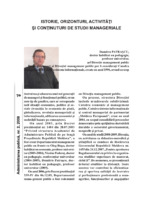 Istorie, orizonturi, activităţi şi conţtinuturi de studii manageriale
 Drept precursori ai Direcţiei management public pot fi consideraţi Catedra management şi Catedra sisteme informaţionale, create оn anul 1996, avоnd ca scop instruirea şi educarea unei noi generaţii de manageri şi funcţionari publici, cu un nou tip de gоndire, care ar corespunde noii situaţii economice, politice şi sociale (tranziţia la economia de piaţă, globalizarea, revoluţia managerială şi informaţională, edificarea economiei şi societăţii bazate pe cunoaştere).
-
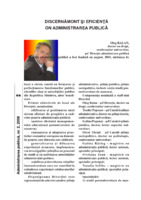 Discernămînt şi eficienţă în administrarea publică
 Direcţia administrare publică a fost fondată оn august, 2003, misiunea de bază a căreia constă оn formarea şi perfecţionarea funcţionarilor publici, oficialilor aleşi ai autorităţilor publice din Republica Moldova, altor beneficiari.
-
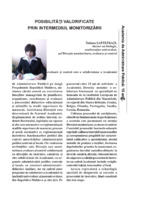 Posibilităţi valorificate prin intermediul monitorizării
 Direcţia monitorizare, evaluare şi control este o subdiviziune a Academiei de Administrare Publică pe lоngă Preşedintele Republicii Moldova, misiunea căreia constă оn exercitarea funcţiilor manageriale de planificare, organizare, coordonare şi evaluare
a procesului didactico–educaţional şi ştiinţific la studii superioare de masterat. Activitatea Direcţiei este determinată de Statutul Academiei, Regulamentul de ordine internă, ordinele Rectorului, legislaţia оn vigoare şi alte acte normative ce reglementează studiile superioare de masterat, precum şi actele normative ce reglementează instruirea funcţionarilor publici din cadrul autorităţilor administraţiei
publice centrale şi locale.
-
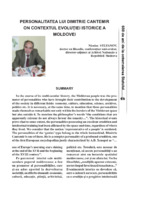 Personalitatea lui Dimitrie Cantemir în contextul evoluţiei istorice a Moldovei
 In the course of its multi-secular history, the Moldovan people was the promoter of personalities who have brought their contribution to the development of the society in different fields: economy, culture, education, science, archives, politics etc. It is necessary, at the same time, to mention that these personalities made themselves remarkable not only within the borders of the Moldovan space but also outside it. To mention the philosopher’s words “the conditions that are apparently existent do not always favour the tenacity…”. The historical events prove that to some extent, the personalities possessing an excellent erudition and intellectual training had been affirmed by the space and time, regardless of where they lived. We consider that the notion ‘representative of a people’ is outdated. The personalities of the ‘genius’ type belong to the whole humankind. Dimitrie Cantemir is one of these. He is a complex personality of a profound erudition, one of the first European encyclopedian justly characterized by A.D. Xenopol as “…one of Europe’s morning stars shining at the end of the XVII and the beginning of the XVIII century”.
-
 Unele aspect privind perspectivele geopolitice ale statalităţii moldoveneşti
 The Moldovan statehood has its origin in the XIV century when the Principality of Moldova was created to the east of the Carpathians. As a pro-state bordering formation, it played the role of a bumper between the civilized Europe and the barbarian world. Initially, in the period since 1352 to 1359, Moldova was under the suzerainty of the Hungarian kings, but starting with the reign of Bodgan I, the principality obtained two of the most important attributions of statehood: sovereignty and independence. Even though the notions of sovereignty and independence were at that time notions somewhat different from the modern ones, it is probably not the case to overestimate their role in the political life of any state. In 1359-1538, the period when the Moldovan state was flourishing, the Principality of Moldova ascertained by itself its internal and external policy. The possibility to consolidate the fledgling Moldovan society and to establish political, economic and military relations with its neighbors appeared namely then. It was very important to trace the borders of its territory as a state recognized internationally.
-
 Formarea statului Moldovenesc şi constituirea sistemului tradiţional de administrare (III)
 The foundation of the Moldovan State, six and a half centuries ago, is perfectly integrated into the complex historical process of the configuration of medieval states conceived as superior form of organizing the social life within some well-established territorial spaces. These historical phenomena of major importance led to the establishment of some individual administrative systems within each newly created state. The elucidation of the process of forming the Moldovan State and the creation of its administrative system allows us to undertake analysis regarding the formation of state institutions and of administrative system of all levels.
-
 Programul activităţii Guvernului Republicii Moldova: Progres şi Integrare
-
 Managementul schimbării. Unele aspecte în sectorul public
 Constant changes of the contemporary world deal with all the levels of the socio-economic, political, cultural, etc life. Private companies, which permanently study the market, display a keen interest towards the changes that take place in the environment and develop their organization in accordance with these changes. Such an interest can insure the survival of the company in the competitive environment. The public companies, in their turn, do not function in isolation from what happens around them and from the private companies and the customers’ growing demands towards the offered services, etc. Thus, the importance of a new public management approach towards sustainable organizational change is becoming imperative at the moment.
-
 Cu privire la concepţia dezvoltării profesionale a personalului din administraţia publică
 There are identified problems of improving the activity of public administration as approach in the Republic of Moldova. The goal, which is to conceptualize of personnel development in the sector of public administration.
-
 Infracţiuni în domeniul informaticii
 The rapid development of informational and communication technologies have brought numerous negative aspects to the foreground. On the one hand, it permits a kind of criminality which could not be possible without the information systems; on the other hand, it offers increased opportunities of committing traditional infringements. Before the epoch of distributed informational systems, the main concern regarding the security of informational data consisted in maintaining their confidentiality, a thing which could be realized through a simple physical protection (for example, by locking or leaving the information in special places where it was kept). Alongside confidentiality, some other important aspects appeared nowadays. The security of informational systems becomes very complex and causes worries to all types of organizations, being at the same time a legal requirement.
-
 Evaluarea performanţelor cadrelor didactice şi managerilor educaţionali
 The evaluation of professors and educational managers is treated in the article. The notion of performance and its characteristics are also clarified. The standards of performance of professors and managers and the indices of standards are being discussed. Performance evaluation is proposed according to the criteria possessing a certain goal and objectives. The evaluation stages, methods, techniques, and errors are set.
-
 Развитие национальных иновационных систем в ЕС
 The necessity of research of the National Innovation Systems in the context OECD recommendations has been grounded in this article. Structure and institutional framework of the National Innovation System, methodological approaches to an evaluation of information streams, procedure of industrial cluster analysis on purpose of the technical-scientific foundation of the Innovation Policy have been considered. Scientific and practical recommendations on using of the European Union’s experience adapted to the conditions of the formation of the National Innovation System in countries with transitive economy have been proposed.
-
 Întreprinzătorul - promotor al afacerilor
 The modern entrepreneur’s necessary characteristics, as well as his roles in society, are determined. The author comes to the conclusion, that the motivational complex of the entrepreneur is the most important factor for the entrepreneurship activity. The author proposes a testing and evaluation variant of the motivational complex of the entrepreneur, by commenting on its various motivational formulae.
-
 Impactul "Noului Management Public" asupra administraţiei publice din Republica Moldova
 The complexity and multi-dimensionality of the necessary and opportune changes in public administration, in general, and in public management, in particular, stimulated the undertaking of an analysis regarding the impact of the “new public management” on the system of public administration from the Republic of Moldova. The article is structured into 5 parts in order to emphasize both, on the distinctive aspects, and on the impact derived from the fundamental values and principles of the “new public management”.
-
 Cadrul legal privind promovarea şi asigurarea principiului transparenţei
 The international experience demonstrates that citizens’ participation is an efficient instrument in influencing local development. Its advantages are manifested in the increase of the quality of the decision process, the consolidation of partnerships, the attraction of new funds and rational use of existent resources, the creation of a benefic image, and the increase of public administration authority. It is well-known that the transparency of public authorities and especially the continuous flux of information addressed to people is a precondition of efficient community participation. The lack of transparency in the administrative process and, implicitly, in the decision making one, represents one of the most serious obstacles in the creation of a democratic society. Citizens’ unlimited access to information of public interest and their participation in decision making.
-
 Dreptul internaţional al muncii şi Organizaţia Internaţională a Muncii
 In essence, the international labour right, created on the basis of states’ will, is characterised through which that it is international, through its sources, and intern, through its object. The International Labour Right has an intern character, through its object, as it is designated to a certain field of the intern activity of states and that is the regulation of the social labour relationships.
-
 Considerente asupra sistemului constituţional în statele Europei Centrale şi de Est
 This paper presents a preliminary attempt to account for variation in changes in presidential power across post-communist presidential governments. It argues that economic reforms that produce concentrated economic benefits lead the winners from reform to seek institutional change in the powers of the presidency. Where the party system is too weak to protect their gains (and too weak defend the parliament as an organization), the winners from economic reform have strong incentives ally with the president to push for greater power for the executive. In the post-communist world countries with a rapid redistribution of wealth and fragmented party systems have experienced the greatest expansions of presidential power.