-
 Problema egalităţii suverane a statelor membre şi candidate la Uniunea Europeană
 National sovereignty has been the most discussed subject within the European Union (EU) since the Rome Treaty signing. Thus, the European Communities are positioned on three basic international treaties that have an impact on member-states‘ sovereignty. We can observe at present the transfer of sovereign competences from member-states to Community institutions stipulated in these and other further treaties. “Shared sovereignty” is a better definition to what we have today in the EU. The aim of this transfer is the fulfilment of the public tasks that the state is not able to perform in the context of globalization. Therefore, we try to present some solution-proposals dealing with the sharing of sovereign rights between EU institutions and the member-states in this work. This article cannot stop us from considering that adhering to the EU Constitution means the realization of the concept of “sovereignty restriction”, but, from our point of view, the reason to accept this matter of fact for one group of states is the need, and for the other countries – the interest to cooperate. This very relation “necessity (need) – interest” creates the situation when the states are not equal in terms of sovereignty in the framework of EU activity.
-
 Impactul Planului de Acţiuni Republica Moldova - UE pentru integrarea europeană a ţării
 The EU-Moldova Action Plan is a political document laying out the strategic objectives of the cooperation between Moldova and the EU. It covers a timeframe of three years. Its implementation helps to fulfil the provisions in the Partnership and Cooperation Agreement (PCA) and encourages and supports Moldova’s objective of further integration into European economic and social structures. Implementation of the Action Plan contributes to significantly advancing the approximation of Moldovan legislation, norms and standards to those of the European Union. In this context, it helps build solid foundations for further economic integration based on the adoption and implementation of economic and trade-related rules and regulations with the potential to enhance trade, investment and growth. It furthermore helps to devise and implement policies and measures to promote economic growth and social cohesion, to reduce poverty and to protect the environment, thereby contributing to the long-term objective of sustainable development.
-
 Learning Organization. A new perspective of efficient Public Management in the Republic of Moldova
 Articolul de faţă conţine idei şi concluzii esenţiale, la care a ajuns autorul in cadrul cercetării, obiectualizate in teza de master cu aceeaşi denumire, care a fost susţinută public pe data de 13 iulie 2007. Organizaţiile secolului XXI funcţionează in epoca revoluţiei informaţionale şi manageriale, care are drept rezultat apariţia paradigmei organizaţiei cognitive, fiind aplicabilă tuturor instituţiilor, inclusiv şi celor publice оn cadrul concepţiei noului management public. In procesul de tranziţie a Republicii Moldova la economia de piaţă şi cea a cunoştinţelor, apare o necesitate evidentă a unor noi concepţii, forme şi metode manageriale, una din acestea fiind organizaţia cognitivă. Sectorul public al ţării noastre se află in procesul de transformări continue, insă nu intotdeauna reuşite. Modernizarea acestuia, mai deosebit reforma administraţiei publice centrale, constituie o prioritate majoră a unui management public performant. Academia de Administrare Publică pe lоngă Preşedintele Republicii Moldova, graţie statului său unic, are o şansă deosebită şi o misiune de onoare să aprindă făclia mişcării pentru organizaţia cognitivă pentru sectorul public autohton. Numai devenind electronică şi bazată pe cunoştinţe, Academia noastră poate avea succes pe acest tărоm, astfel dovedind ipoteza, că organizaţia cognitivă este cea mai optimală formă managerială in condiţiile unui mediu organizaţional extern оnalt turbulent, inclusiv şi pentru instituţii publice.
-
 О формализации использования знаний при дистанционном обучении
 The paper analyzes the issues of automated structuring of knowledge in teaching, which can be achieved with the help of the so-called “matrix of knowledge elements” worked out based on Aristotle’s category on the one hand, and the demands of psychology and pedagogy, on the other hand. The goal is further improvement of the methods and systems of automated structuring of knowledge and its usage for the creation of: professor’s working place (means for the automated structuring of the taught material), professor’s virtual assistant (the system for the automated dialogue with the students), the medium for the students to prepare reports, explanatory notes about how to design a research project and a diploma thesis, virtual consultant and tester for students’ self study and other uses. The paper contains examples of the automated structuring of knowledge process. There are also assessed the perspectives of using the UEAM-SOFT “QUEST” in the ‘teaching’, ‘consulting’, and ‘knowledge testing’ regimes with the help of the knowledge matrix. The use of the system as a professor’s virtual assistant in the case of distance learning by means of Internet is specially emphasized.
-
 Некоторые проблемы информатизации современного молдавского общества
 Information is treated as something separate from such categories as matter and energy. More and more facts and identified regularities signal in favor of the priority of information over matter and energy. It is proposed to consider information as substance that has its specific features. Concrete technologies of building modern information databases are named and measures for the intensification of informatization of all the spheres of the society’s activity are proposed.
-
 Problema educației economice în contextul liberalizării economiei
 The problem of economic education in the context of liberalization of the economy of the Republic of Moldova is treated in the article. The main moments, reflected in the article, refer to economic education and its content, educational products, quality of human resources, human capital, theory of capital, educational demand, educational market, economic thinking, etc.
-
 Consideraţii privind principiile de funcţionare a mecanismului de coordonare a serviciilor de instruire a personalului din autorităţile administraţiei publice
 The creation of a modern and transparent system of public administration constitutes one of the main concern activities of the Government of the Republic of Moldova. All internal and external resources, necessary for the development of the given sector, have been mobilized in this aim. A legislative and institutional framework, adapted to the requirements of the Republic of Moldova’s integration in European Union bodies, has been created. The analysis of the current state of civil servants’ professional development trainings reveals the existence of a number of issues, whose solution will contribute to the provision of the quality of trainings for civil servants through the elaboration and implementation of a mechanism to coordinate the training events for the personnel functioning in public administration institutions. The proposed mechanism presupposes the formulation of clear demands forwarded to the trainers of professional development courses for central and local public administration personnel. The management of the proposed mechanism will be carried out by the Academy of Public Administration, Office of the President of the Republic of Moldova, in collaboration with the Governmental Office. An example, in this sense, is offered by Civil Servants’ Training and Testing Centers in the field of informational and communication technologies and electronic governance.
-
 Agricultural Policies in Central and Eastern European Countries
 Extinderea spre Est a UE este o opţiune istorică şi economică de mari proporţii, care va crea o nouă arhitectură europeană şi mai multă stabilitate economică şi politică. Agricultura este un sector important in economia acestor ţari şi va juca un rol esenţial in formarea economiei agroalimentare moderne. Majoritatea ţărilor Europei Centrale şi de Est au nevoie de investiţii importante pentru modernizarea şi restructurarea producţiei agricole şi a sectoarelor din aval. Ele se confruntă cu trei categorii de dificultăţi : a) lipsa capitalului necesar modernizării agricole rurale şi a infrastructurilor bancare; b) existenţa unor structuri agricole neperformante şi contracţia pieţei interne; c) lipsa unor structuri de organizare adecvate avalului agriculturii.
-
 Politica socială a statului și problemele finanţării sferei sociale în Republica Moldova
 The present paper reviews the concept of social politic and financial problems in the social sphere in the Republic of Moldova. The author describes the social situation and makes recommendations based on the experience from other countries. Also, he defines the relevant problems and how to overcome them. The paper promotes the perspectives of the financial problems in the social sphere
-
 Программа оживления экономики Республики Молдова
 The main paradigm of the present stage of economic development of the Republic of Moldova is that our economy is a battle field between the shadow and legal business, but, unfortunately, the latter loses this battle. The task of Moldovan legal business (that pays taxes) is not only to equalize the score, but to win! For this, it is necessary to make the legal form of running business more attractive and efficient in comparison with the illegal entrepreneurial activity.
-
 Interdisciplinaritatea știinţei administraţiei şi a cercetării ştiinţifice a administraţiei publice
 The interdisciplinary character is a cooperative, unifiying and encoding process of the theoretical disciplines applied to the science of administration. The science of administration is not alien to it, the use of a self criterion of a scientific character, to render theoretical basis to the public administration, including the judicial one.
-
 Urbanismul Basarabiei în secolul al XIX-lea
 L’article suit la politique urbaine dans la Moldavie de l’Est (la Bessarabie), qui de 1812 est partie composante de l’Empire Russe. Зa se base sur l’imposition de nouveaux principes, caractйristiques а l’йpoque de la rйgularisation. On appelle souvent aux services des ingйnieurs et des architectes russes, qui viennent aux visions propres de „villes idйale”, planifiйes „en caroyage”. Dans beaucoup de cas, on trouve un contraste frappant entre la nouvelle partie de la ville et celle vieille. Aprиs les activitйs des autoritйs tsaristes on change la physionomie des villes de la Bessarabie, qui est dйterminйe par le spйcifique du classicisme russe.
-
 Promovarea politicii de stat în domeniul serviciului public din Republica Moldova
 The author of the present article analyzes the complex of methodological and didactic activities, their efficiency and role regarding the contribution of the Academy of Public Administration, Office of the President of the Republic of Moldova, in the promotion of the State policy in the field of public service in our country. The scholar mentions that the Academy’s Action Plan regarding the development and capacity strengthening has recently been elaborated. It essentially contributes to the edification of the democratic state of law and to the effectiveness of the activity of the system of public authorities at all levels. In the context of the fulfillment of the stringent opportunities for a more efficient promotion of the State policy in the field of public administration, the optimization of the training and evaluation system of the personnel, as well as, the need for the consolidation of the organizational, methodological and scientific basis of the activity of public authorities, the rector of the Academy underlines that the Senate has established the priority direction of research for the academic personnel, and namely “The edification of the state of law and the consolidation of the public administration.
-
 Vasile Tarlev: Noi sarcini şi obiective ale şcolii naţionale
 Cu certitudine pentru fiecare dintre noi, cei ce am păşit vreodată pragul şcolii оn prima zi de şcoală, această sărbătoare a devenit un simbol al оnfăptuirii unor lucruri măreţe, a unor
reforme оndrăzneţe, a unor noi descoperiri şi realizări.
-
 Менеджмент в государственной службе Республики Молдова
 The public service of the Republic of Moldova is at the stage of development and shaping of its concept, i.e. a system of outlooks on goals and principles of personnel administration. This specifies the high urgency and importance of the above problem: theoretical aspects, public personnel policy mechanisms, existing legislative basis, as well as personnel policy improvement prospects within the Republic of Moldova are investigated in details adjusted for the experience of the states – members of the European Community, and also for the critical goal of our state – an integration in the European Community. Modern personnel strategies in the public management presented in this essay are the possible paths to improve the public management administrative reformation in the Republic of Moldova.
-
 Organizarea şi gestionarea şedinţelor în administraţia publică locală
 The local council is a collegial body. This means it can only function effectively if it meets in sessions. However, very few people understand that the success or the failure of any meeting depends on its organizational arrangements. A successful session needs an effective time and space management, as well as an information and public communication campaign (both of the local government and the local community). In order to be effective, a session should also be moderated in a collegial and constructive manner. Also, the arrangements for a successful meeting do not end after it is finished. Au contraire, other arrangements, such as information, preparation of the minutes an other materials, as well as their archiving, are to be made. This ensures sessions’ effectiveness. This is especially true for the public administration, which decisions affect the entire community. Key words. Public administration, local government, local council, mayor, council secretary, session, time management, meeting, organizational arrangements, transparency, documentation, minute, administrative decision.
-
 Locul şi rolul administrației publice locale în organizarea şi funcţionarea servicilor publice
 Public administration has two basic missions - execution of laws and providing of public (municipal) services. It is impossible to imagine life in the society without the issuing of official acts, without gas and water services, without transportation, without the appointment of a guardianship, or without the social aid. Considering the fact these services are nothing but activities of general interest, they can only be provided by the public administration, which very goal is the fulfillment of those interests. However, the key role in that is performed by the local government, because the local bodies are the closest to the people of any administrative unit, and, therefore, know the best all the needs of those people. Both the local deliberative body and the executive one have significant competencies in establishing and closing down of municipal services. Moreover, local government can also decide upon the form of managing these services - direct or conceded management. Given the importance of these services, it is imperative for public administration to continuously work on improving their quality. Key words. Public administration, local government, services, municipal services, local council, mayor, direct management of municipal services, conceded management of municipal services.
-
 Direcţiile strategice de dezvoltare a comunităţilor rurale
 Country’s lasting development, as a whole, depends on the development of each local collectivity, on their capacity to elaborate and to promote the best social and economical policy for their community. For this purpose, the local collectivities have to identify the catalytic matters to be solved, as well as to find the optimal solutions. The strategic ways of rural collectivity development are determined by life realities and are established both under the National Strategy of social and economic development and Regional Strategies. They are: - reorganization, modernization, efficiency of the existent agricultural exploitations; - development of non – agricultural economic activities, including service rendering, manufacturing, rural tourism etc.; - rise in living standards to rural population by improving the system of its social protection, extension of motorways, informational systems, development of education and culture; - investment drawing etc.
-
 European tourism market
 Tourism is one of the largest and most dynamic industries of the world, with significant multiplier effects on economic activity. It is estimated that over the next ten to fifteen years demand in the sector could double globally and increase by around 30% in Europe (Torres Marques 1998). Recent worldwide trends seem to justify this estimation,
particularly the continuous ageing of the population of the developed countries, the gradual reduction in working hours and the consequent increase in leisure time or the expected improvement in the quality of life of potential tourists all over the world.
-
 Organizaţiile internaţionale şi folosirea forţei
 This article is about the international, national and regional security system and the forms of using the force by the International Organizations. Besides the cases relevant by the legitimated defense or application of states agreements, juridical norms and practice, make the last appeal to force a privilege of International Organizations – reflecting by these, the international community care for setting the force in humanity benefit. The role of International Organizations is prominent in debating and solving different conflicts.
-
 Noi tendinţe în modernizarea învăţământului
 This article contains the results of the realities and prospects fulfillment of the lyceum studies in Republic of Moldova from high school position and systematical analysis.
-
 Oportunitatea şi importanţa teoretico-practică a asigurării calităţii învăţământului
 This article outlines the problem of the opportunity of quality education, being treated in the logic of “quality of education - quality of man - quality of life”. There are revealed the dimensions of educational quality, its ensuring as planning and potential. They are treated from the point of view of qualitology, by levels. There are distinguished three approaches (pedagogical, quality management, multidisciplinary theory). There are made attempts to bring up the problem of developing the educational quality concept in pre-university institutions. There are proposed actions for ensuring the quality of education in Republic of Moldova and there are specified problems needed to be resolved.
-
 Consideraţii privind instruirea universitară şi postuniversitară în domeniul administraţiei publice, realizări şi tendinţe
 The problem of university and post -graduate studies in the field of public administration represents a priority for the Republic of Moldova on the way to state consolidation and European standards of governance implementation. The evaluation of accumulated experience, the study of international practices in the field, wording efficient solutions and training highly qualified staff is very important in the process of administrative reformation in the Republic of Moldova. Utilization of these suitabilities depend on the will and qualification of the teaching staff whose activity is aimed at adjustment of the science of Public Administration to the academic international standards.
-
 Constituirea şi evoluţia sectorului economic public în Republica Moldova
 Articles designated for examination of problems of construction, affirmation and causes of growing of public sector in countries with market economy. A special attention is paid to the evolution of the public sector in the Republic of Moldova.
-
 Evoluția Managementului Public - suportul integrării europene
 Public management is a perspective on government and non-profit administration which contends that public and private-sector management are alike in most important ways. As such, there are management tools to be taught to bureaucrats—whether public or private—and those are applied to maximizing [government] efficiency and effectiveness. The scale and complexity of assets involved can be similar in private and public management. However, it is far more likely that the public manager will deal with critical infrastructure that directly and obviously impacts quality of life. It is far more common for a public service, e.g. municipal services, to be a monopoly - to have no competitors whatsoever.

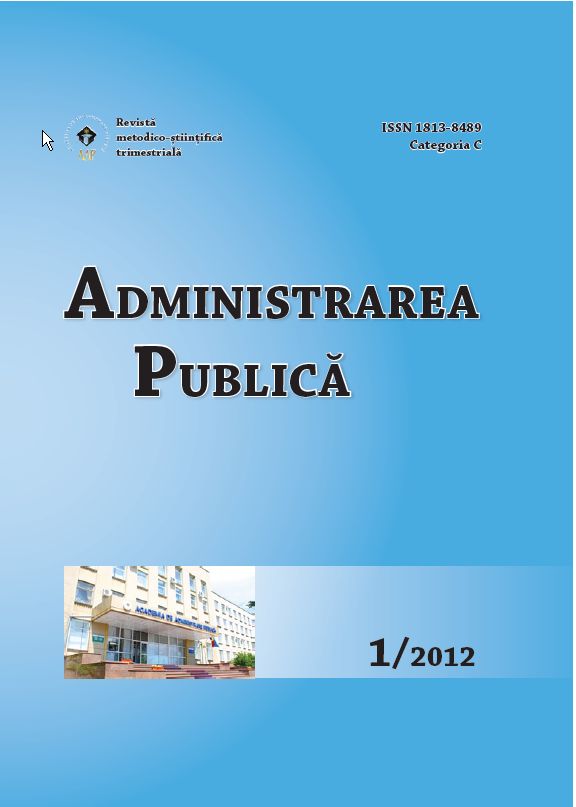 Revista „Administrarea Publică” - 2006
 Revista „Administrarea Publică” - 2020