-
 Managementul proiectelor - soluţie eficientă pentru atingerea unor obiective de anvergură
 After studying this article you will get answer at a number of questions: what is a project, purpose, advantages and disadvantages of project management. Project management description is possible through the life-cycle project analysis. The design of programs required a project cycle formed by several steps, which they are. Which are the major phases of a generic life-cycle for international development project. What responsibilities has a project manager. These are just some of questions resulting from development projects that require answers.
-
 Aspecte multifactoriale ale sistemului de adoptare a deciziilor administrative în cadrul complexului agroindustrial
 Presently, the problem of qualified administrative decision taking gains a great importance. In the given article the specific characteristics of a multifactorial system of administrative decision taking are regarded, as well as the implementation process of analyzed adaptive informational technologies and the forecasting in agroindustrial complex.
-
 Renta funciară şi formele sale de manifestare
 In this article are reviewed the category nature and content of rent, premises, conditions and land rent source; its manifestation’s forms; land price; land rent specific event in the Republic of Moldova.
-
 Metodologia administrării cheltuielilor publice în scopul eficientizării lor
 In this article are investigated analyzing methods of social programs. One of these methods is the analysis of cost-effective as a variant of cost-benefit analysis. It is true that not all public services can be measured in money. In such a case, it is use cost-effectiveness analysis, which, for example, measure the effectiveness of public service in lives saved. Therefore, a life saved can not be measured in money. Cost-effective analysis (ACE) does not express benefits in monetary terms. However, it is noted that the ACE uses, inevitable, two different units: a) costs are expressed in monetary units; b) efficiency can be measured in natural units - number of vaccinated children, tonnes of waste household processed, number of lives saved and so on. In this article we have tried to determine techniques and procedures for performance measuring of social projects.
-
 Коммуникационные возможности и условия реализации разнообразных форм гражданского участия в современном обществе
 A concept «Civil participation» is examined as a necessary constituent of process of democratic transformations in society. The various forms of such participation and expansion of terms and possibilities of their realization are analyses in modern informative space.
-
 Răspunderea civilă (patrimonială) a procurorilor în Republica Moldova
 Ensuring that the rights and freedoms of citizens in criminal and administrative proceedings, led by prosecutors is a dire necessity and responsibility Declaration of a State of law. Civil liability (Heritage) of prosecutors for illicit actions and errors in criminal and administrative proceedings, in which participates as a representative of the State, and for which they are responsible for the work of management, oversight and control, is a form of legal liability necessary to its existence in domestic law, among other forms of legal liability of the prosecutors. Through the existence of domestic legislation is of such forms of legal liability that is carried out against prosecutors, the State shall ensure justice and fairness in respect of persons to whom the prosecutors’ actions have brought some economic damage. The article in question comes to elucidate some particularities of civil liability (property) of the prosecutors, the initiation and examination of such actions as well as the collection of economic reward due to which a citizen has been illegal and which caused the Prosecutor guilty of such injury.
-
 Raporturile şefului de stat cu organele executive
 Les rapportes du chef d’État avec les autorités exécutives dépendent de l’endroit lui attribué dans le système d’organes de l’État. Le contenu des relations dépend du régime constitutionnel établi et de la Constitution, qui causent expressément le lieu du chef d`État dans le système constitutionnel ou il peut révéler la place et le rôle des pouvoirs conférés par la Constitution. Étant donné que la Constitution de la République de Moldova ne stipule pas expressément la place du Président de la République de Moldova dans le système du pouvoir d’État, le problème reste discutable. Dans une analyse comparative de la relation entre le chef de l’État et les autorités exécutifs d’État dans les arrangements constitutionnels différents, nous pouvons conclure que le chef de l’État, traditionnellement, fait partie de l’exécutif, même si cela n`est pas désignée dans la Constitution.
-
 Regimul constituţional al autorităţilor publice locale cu statut juridic special
 The main topic treated in the article by its author is legal corelation beetwen central authorities’ responsabilities and local autonomous authorities’ competences within issues what is subject of interest for both levels of administration.
-
 Partidul octombrist - exponent al ideilor liberale în Basarabia la începutul secolului al XX-lea
 Les partis politiques libérales en Bessarabie au début du XXe siècle, de l’organisation, on peut estimer que certaines structures fragiles qui ont réussi à recruter sous leurs drapeaux seule une partie de la société Bessarabie, avec des répercussions sur les faiblesses politiques.
-
 Conflictul de interese în administraţia publică
 This article addresses a particular type of conflict of interest in the civil service – the one resulting from contradictions between political orientation of a civil servant and his job duties. Such conflict emerges when the term in the office is used to promote interests of a certain political group. Causes of this type of conflict of interest are to be analyzed in the article, as well as the manners of expressing it in case of state dignitaries or career servants. Finally, political implications for the society are to be identified as well.
-
 Social capital as an economic phenomenon
 Research is devoted to the study of the phenomenon of the social capital as an economic phenomenon. The author’s definition of the social capital is given, the sources of its formation are investigated, the approaches to the formation mechanisms of the potential of the social capital at different levels of the national economy are developed, a set of the social capital produced by the direct and indirect effects is investigated. The theoretical foundations of quantifying the value of the social capital are laid.
-
 GIS for optimizing location of primary health care facilities in rural areas: a case study in Barskyi and Sokalskyi rayons, Ukraine
 The article examines possibilities of using GIS technology in decision-making in health care. The software ArcGIS for Desktop (ESRI), application ArcMap, was used to complete the task. The capabilities of geospatial analysis to assess health care at local level have been considered. The GIS analysis effectively identifies problem areas with limited access of the population to primary health care (case study: Barskyi Rayon, Vinnytsya Oblast and Sokalskyi Rayon in Lviv Oblast). It is proved that geospatial analysis is a useful tool for problem solving on forming an optimal network of primary health care through restructuring and conversion of existing facilities in ambulatory of general practice / family medicine.
-
 Democrația directă – principiu integrat al dezvoltării Elveției
 Discussions about direct democracy and its advantages and risks are often superficial, invoke stereotypes and ignore empirical data. Evidently, Swiss democracy is not a copy/paste model, but has developed in a specific historical and institutional setting. It is obvious that both conservative as well as left-wing critics overemphasize their case against direct democracy by (wilfully) neglecting the evidence. Direct democracy does not lead to anarchy. The common people can make reasonable decisions. Minorities are not more discriminated in direct democratic systems than in representative ones. Direct democracy brings contentment to its citizens. Finally, direct democracy is not ideologically predisposed. It is a mechanism to revert policies back to the median voter.
-
 E-guvernarea Republicii Moldova organizată şi dirijată ierarhic în baza unui proces decizional emergent aspirațiilor spațiului comunitar european și nivelului internațional
 The scientific publication shows some diversified solutions in accordance with activities of egovernment of the Republic of Moldova in order to apply decision making uniform process, making public and private sector similar to E.U. and global standards. These hierarchical relationships denote dominant feature of macro-procedural standardization, internationalization etc. E-government of the Republic of Moldova can overtake previous stereotypes through new infiltration of the E.U. prototypes and international models of decision making process in order to create a common opinion and unified historical origin of the ideology of the new generations in micro and macroenvironment which develops nanotechnology.
-
 Interferenţe între eficientizarea procesului decizional administrativ şi modernizarea administraţiei publice
 In this article, we are going to discuss about two processes, which are very important for public administration, with references to decision-making process, and modernization of public administration. We’ll study if between these two processes are any relations, and if they are, how these relations can affect any of these two processes. We’ll search if the process of modernization of public administration implies also the improvement of administrative decision-making process. In the same context, we’ll study how decision-making process can influence de process of modernization the public administration.
-
 Colaborarea universităților la Marea Neagră prin intercalarea valorilor și soluțiilor comune
 The project University collaboration Network at the Black Sea – UNIVER-SEA. NET, is financed by the E.U. within Black Sea Basin Joint Operational Programme 2007- 2013, managed by the Ministry of Regional Development and Public Administration. The overall objective of the project is promoting exchange of educational values and experiences between universities in partner countries through a joint educational program and network, having as specific objectives the identification of the common components of educational programs between universities in partner countries and promoting educational values, by means of using online and offline instrumets, as well as strengthening our regional identity by creating community between universities.
-
 Diplomaţia economică şi impactul problemelor energetice asupra relaţiilor internaţionale la începutul sec. al XXI-lea
 One of the essential components of state power in all times was and is the access to resources - land, water and energy. However, with technical and scientific progress, the rapid growth of industrial production, the transition from fossil fuels (coal and oil) that determines the role and place in developing countries lies with a separate energy reso¬urces. The crucial role of hydrocarbons, which became the basis for the development of the modern economy, was mostly manifested during the Second World War, when the outcome of battles depended on largely stable supplies of crude oil and the possibility of producing fuel at scale. Highlighting the political component of energy security and growing interdependence between the economic and political aspects imposed by the necessity to analyze trends in international economic relations under current energy conditions.
-
 Metode și tehnici de promovare a instituțiilor publice sau a funcționarilor publici în mediul online
 Promotion is the key to success, whether it comes from a company at a public institution or a person. Promotion is the element that makes us known, heard and understood, is the bridge that connects different persons seeking promotion and target audience.
-
 Responsabilitatea socială – instrument de management pentru administraţia publică
 The purpose of the article sets out to describe the role of Social Responsibility (SR) in government policy and examine its relevance to a particular sector, the regulated utilities. Current theoretical and political activities conducted at the national and international level, suggest a widespread interest shared by government, regarding the role of government for the natural environment, social development and social inclusion.
-
 Моделирование и пути достижения стратегической конкурентоспособности предприятия
 This paper presents a process of modeling competitiveness at the firm level for strategy formulation purposes. The modeling process consists of next interactive components: managerial situation, conceptual model, formal model and strategy. These components are interacted through four sub-processes named conceptualization, modeling, obtaining solution and implementation.
-
 Impactul provocărilor economice asupra managementului și ergonomiei clinicilor medicale dentare
 For each individual, as for the entire community, health is the most important factor that ensures the evolution of life and activity. Therefore, maintaining health is not only a health problem, but also a major problem in economic and social development of each country. Moreover, health policy must be a key part of the government’s concerns and significant financial resources are spent in many countries. World Health Organisation is aware of the size of the problem combining global as well as local health policies, aiming to promote oral health together with the health of the entire body. Control of oral cavity diseases through prevention and treatment should focus on addressing common risk factors of oral and general diseases. Ergonomics play a fundamental role in dentistry, targeting human, environmental and technological factors as well. Upgrading healthcare (laser, CAD-CAM, RoboDent, etc.) represents a major objective nowadays, contributing not only to the early diagnosis and correct treatment, but also for maintaining the health of the dentist and increasing the professional efficiency.
-
 Государственно-частные инструменты наращивания стоимости институциональных элементов национального богатства
 This article investigates the question of assessment of the national wealth in sectors of economy. Studies the international practice of similar calculations, method of construction of the national and regional levels of government balance sheet. The directions of deepening the meaningfulness of analytical procedures for the non-financial and financial elements of wealth justified. Are examined the possibilities of expanding the number of elements of the calculation, which are valued with the assistance of market-based instruments. The composition of the elements of the consolidated balance sheet of the national economy is described in detail. Tools escalating cost of institutional elements are represented in the form of manifestation of public-private cooperation. Experience in building the consolidated balance sheet of the national wealth accounts for practical advice on the construction of the individual elements in the Ukraine and Great Britain
-
 Măsurători ai bunăstării și prosperării
 Well-being, welfare or wellness is a general term for the condition of an individual or group, for example their social, economic, psychological, spiritual or medical state; a high level of well-being means in some sense the individual or group’s experience is positive, while low well-being is associated with negative happenings. In economics, the term is used for one or more quantitative measures intended to assess the quality of life of a group, for example, in the capabilities approach and the economics of happiness. As with the related cognate terms ‘wealth’ and ‘welfare’, economics sources often contrast the state with its opposite.
-
 Cовременные тенденции экономического регулирования инновационного развития системы высшего образования
 The consensus in the high school is valued by how much we invest in human capital which is determinant of efficiency. High school is a pillar contributor to productivity growth. There is evidence that innovation is a key player in nurturing technology change. In today’s knowledge based economy, it becomes more evident that investing in human capital has greater return for university and corporation which is more effective than that of physical assets. Simultaneously, the conceptual fundamental of human capital is based on knowledge, skills, competencies, and tools that are developed through coaching and learning activities provided by the concerned institution. This paper intend to tackle and to develop separate positions of the theory and practice of financing the innovative development of higher education (IDHE) toward the formation and development of the national economy of knowledge. Furthermore, it examines the retention of the increased globalization of higher education, while state financial obligation is in decrease, which leads to greater distinction among universities in respect of financial support and security. Financial support should be a priority to support the innovative development of higher education.
-
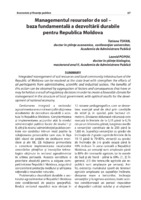 Managementul resurselor de sol – baza fundamentală a dezvoltării durabile pentru Republica Moldova
 Integrated management of soil resources and local community infrastructure of the Republic of Moldova can be resolved at the state level with strengthen the efforts of all participants from administrative, scientific and industrial sectors. The benefits of this action can be obtained by aggregation of factors and consequences that have or may be held as a result of regulatory decisions in order to create a favorable climate for management in the structure of local government, with optimal results for the development of national economy.

 Revista „Administrarea Publică” - 2006
 Revista „Administrarea Publică” - 2020