-
 Aspecte sociologice ale traficului rutier
 The sociological aspects of road traffic are determined as a complex and permanent system, consisting of pedestrians, trucks and vehicles, which generates a set of legal and social relations in the process of their movement on public roads and landscaped areas, managed by public authorities.
-
 Iniţiativa Europa de Sud-Est electronică (eESE): angajamente asumate şi bune practici pentru definirea noului document de politici „Moldova electronică”
 The main objective of the Initiative eSEE is integration of the region into the European and global economy based on knowledge and new technologies by providing practical support in promoting modern and balanced policies in information technology and telecommunications.
-
 Managementul utilizării resurselor funciare în economia mondială
 The article demonstrates the use of land resources in different countries and their management. This article analyzes some directions for the improvement of land management resources in global economy.
-
 Aspecte privind contractul individual de muncă pe durată determinată
 The individual labor contract is an agreement between the employee and employer, in which the employee undertakes to perform work in a particular specialty, qualification or function, to respect the rules of the unit, and the employer is obliged to ensure proper working conditions and to pay the salary on time and fully. In the individual labor contract, the duration must be specified explicitly. Otherwise, it is considered that the individual labor contract is concluded for an indefinite period. The individual labor contract concluded for a definite term contains certain specific features.
-
 Practici de elaborare a politicilor de prestare a serviciilor publice informaţionale în cadrul spaţiului administrativ european
 European Administrative Space includes all European countries, including those which are not members of the European Union. Information Technologies play an increasingly important role in public life, including e-services field. All governments tend to democratize the public system through new technologies, especially e-services. Moldova, as part of the European Administrative Space and a country which aspires to European integration, is implementing a series nu_ of public policies for better online services.
-
 Reforma administrativ-teritorială şi impactul acesteia asupra corpului de funcţionari din administraţia publică locală
 Any reform of the administrative-territorial delimitation must have a theoretical foundation, based on the in-depth research of the existing realities. Because namely a good administrative- territorial organization of the country affects both the results of an effective administration and the administrative body itself.
-
 The impact of Diaspora on political processes in Republic of Moldova
 Studiul dat reprezintă analiza impactului diasporei moldoveneşti asupra procesului politic din Republica Moldova. Este examinat rolul diasporei, al funcţiilor sale asupra vieţii politice din ţară, care sunt metodele şi mijloacele de influenţare a evenimentelor politice, în special participarea diasporei la procesul electoral. Se estimează capacităţile diasporei moldoveneşti de a contribui la dezvoltarea proceselor democratice şi de modernizare a Republicii Moldova.
-
 Situaţia juridică în dreptul intern al Republicii Moldova a actelor adoptate de organele de control al aplicării principalelor tratate O.N.U. de drepturi ale omului
 While such titles as the European Convention on Human Rights or the European Court of Human Rights are familiar to the Moldovan legal profession, the core UN human rights treaties and the findings of the UN treaty-based bodies are less-known. The purpose of this study is to remedy in part this issue. After identifying the core UN human rights treaties, the author discusses the functions and the different types of findings by the UN treaty-based bodies. Of particular significance among these findings are the concluding observations adopted following the processing of a country’s report, the views adopted in individual cases, and the general comments that provide detailed content to the generally-worded provisions of the treaties. Despite the fact that concluding observations are not legally binding, they constitute important guidelines for states to ensure the implementation of the human rights treaties. In their turn, the views adopted by some of these bodies, as well as their general comments are of great significance in the interpretation of these treaties. If the Moldovan authorities, like the authorities of any other country, wish to apply and interpret the obligations under the aforesaid treaties in a manner consistent with their object and purpose, they have no choice but to take into account the findings of the UN treaty-based bodies. The author also sustains that these bodies’ views and general comments should be given the same status as the case law, produced by the European Court of Human Rights, enjoys in the Moldovan legal order.
-
 Activităţi nemilitare ale Organizaţiei Tratatului Atlanticului de Nord: repere teoretico-metodologice şi politico-juridice
 The institutionalization and the expansion of non-military activities conducted by the North Atlantic Treaty Organization are examined in the article. The range of such policies including the political, economic, social, technical, scientific, ecological and humanitarian expanded especially after the Cold War which found reflection in the three Strategic Concepts from 1991, 1999 and 2010. The Republic of Moldova cooperation processes involved in the Partnership for Peace program, which it signed on 16 March 1994, refer to developing non-military projects especially in the field of environmental protection and scientific research.
-
 Guvernarea electronică şi democraţia electronică – îmbunătăţirea calităţii serviciilor publice
 The chages that information society brings can be widely seen in the middle of inter-human and social relationships, and also in the relations framework between the citizens of one country and their representants: government, parliament, central and local public institutions. The information flows and most of the public servicies can be easily used in an electronic format, reducing the cost of the resources involved in the present in their realisation and the bureaucracy encountered in those type of relations. The current article describes the facts that generated the e-government and the main types of e-government.
-
 Aspecte privind auditul sistemelor de transport public
 This paper is part of the research efforts to ensure the continuous improvement of transport services for the public within big cities. The article develops the scientific concept of audit for public transport systems and argues its necessity. A logical sequence for the audit process of public transport networks is proposed, and characteristics of audit’s main components are exposed. The need to elaborate, approve and apply the minimal transport standards as an audit benchmark is argued.
-
 Evoluţia resurselor economice
 Until now, public services have often developed extensively. However, public services can be transformed, within certain limits and conditions, in a profitable business. When the society needs capital, public sector can be organized so that the capital consuming organizations,can transform into a generator of capital or makers of profits. To avoid obstacles the institutions can observe social, technological and demographic changes as opportunities in a period of rapid change. Need for social innovation becomes important, and the introduction of innovative leadership in public service institutions may be the most important task in the course of time.
-
 Proprietatea forţată şi perpetuă: trecut, prezent şi viitor
 The forced and perpetual property is a form of co-ownership that emerges independent of the will of co-owners and is reflected upon goods which, by their nature or destination, are used by co-owners of separate premises, and who, collaterally, in addition to that, hold the ideal and abstract share of the common ownership right. This type of real estate property is defined by the term „condominium” and the form of property, by the term „co-ownership.” The notion of forced and perpetual property was introduced in the Civil Code adopted on 06.06.2002. The concept of condominium ownership, in a revolutionary manner, emerged in 2000, with the adoption of the Real Estate Condominium Law (adopted on 30.03.2000). Although years have passed, this form of co-ownership remains still unknown. The adopted norms and regulations aiming at the protection of the forced co-ownership rights are not put into force or are applied incorrectly.
-
 Consideraţii generale privind sistemul de salarizare
 The payroll system includes all the rules which establish the principles, objectives, forms of wage and the necessary tools for control. At the same time, the payroll system comprises the means, methods and instruments for implementation, by determining the conditions of establishment and the provision of salaries.
-
 Securitatea socială în cadrul Uniunii Europene
 All legal norms that regulate relations between social security include the right to social security. Social security is a broad and distinct concept, which can be defined as a task of public authorities with the aim of protecting the population against hazards.
-
 Unele reflecţii teoretice privind parteneriatul social în sfera muncii din Republica Moldova
 The social-political changes which occur in the Republic of Moldova may be successfully implemented in the event of social peace and some coordinated agreements between social partners which represent the interest of the employees, employers and the state. In order to provide an enhanced coordination of standpoints and to take into account the interests of the social partners, which largely seem to contradict each other, the world experience elaborated the social partnership system. This is a system which permits amicable settlement of disputes which arise between the social partners. In this article the author approaches and analyses some aspects pertaining to the social partnership in the area of labour by means of international instruments and the legislation of the Republic of Moldova.
-
 Actele Preşedintelui Republicii Moldova
 Les réglementations constitutionnels des actes du Président de la République de Moldova, qui constitue par son titre l`existence de plusieurs types des actes, se confine sur l`article qui constate que le Président de la République de Moldova, en exécutant ses attributions de service, émet des Décrets nécessaires pour la mise en oeuvre tout au long du territoire de l`Etat. Les Décrets sont publiés dans le Moniteur Officiel de la République de Moldova (l`article 94 de la Constitution). La Constitution de la République de Moldova ne constate pas le fait que le Président de la République de Moldova, en exécutant ses attributions de service, doit émettre aussi des Décrets pour utiliser d`autres formes de l`activité. Dans cette situation spécifique certaines tâches du Président de la République de Moldova nécessitent d` utiliser des expressions avec des effets juridiques et d`autres tâches qui ne nécessite pas à utiliser des expressions avec des effets juridiques. Dans l`article présenté nous analysons en détail les actes émis par le Président de la République de Moldova, en exécutant ses attributions de service.
-
 Ministerul Agriculturii şi Industriei Alimentare: constituire şi evoluţie
 The Ministry of Agriculture and Food Industry is a state authority in charge of implementing the agricultural and food industry policy of the state. Its organization and functioning is mostly similar to that existing in other ministries, when it comes to the internal organization, governing bodies, or legal framework. Given that farming is of major importance to our state, the Ministry of Agriculture, once established, has always been part of our administrative system. Moreover, a new trend is noticeable in the field of continuous consolidation of Ministry functions. Thus, the Ministry assimilates new duties in fields believed to be of major importance for a state – food safety, adjusting food policies to the acquis communitaire, and other.
-
 Sistemul instituţional al administraţiei publice centrale de specialitate din Republica Moldova în contextul edificării statului modern
 In this study are examined some aspects of the organization and functioning of the specialized central public administration in the Republic of Moldova considering the recent regulations that have been made into the Law on specialized central public administration, adopted on May 04, 2012, which will come into force on February 03, 2013. The adoption of this law is an attempt to adjust the institutional system of the Moldovan specialized central public administration to the European model, by assigning clear responsibilities and functions to mentioned authorities as well as streamlining administrative procedures and activities undertaken by them. The specialized central public administration is conceived as a unitary system in which no ministry or other central administrative authority and organizational structures, within their competency framework, may be outside the system. Thus, in the context of these stipulations the law ensures the unity of the specialized central public administration as a system. The social impact of the law will occur at the administrative system level as a whole by strengthening the capacities of ministries and other specialized central administrative authorities in developing and promoting policies of sectoral and intersectoral development, by improving the quality of decision-making process at the Government level as well as ensuring healthy relationships with local public administration and civil society.
-
 Ştiinţa modernă şi societatea (I)
 The paper reveals some facts related to science and society, whose knowledge allows a better understanding of the phenomena that occur in nature and society. The less natural evolution of society imposes a non-triumphant treatment of reality. It also exposes some causes that contributed to affecting man’s superior qualities, his distancing from nature, tradition and the deformation of the human spirit in general. The gap created between the natural and socio-human sciences, on the one hand, and the exaggerated differentiation of others, on the other hand, are among the more specific causes. It is shown that the way in which the social and scientific events evolved has led to the appearance of many negative phenomena. For example, people have become more concerned with personal problems rather than collective ones. In the case of an imbalance between individual and collective interests, such qualities as honour, dignity, honesty lose their value and essence.
-
 Probleme ale implementării politicii fiscale în Republica Moldova
 Repose sur l’idée de Richard Achim Müller ,,La création de l’État moderne a été réalisée par la mise en oeuvre d’impôt , exactement, par les dispositions légales du droit de bénéficier de ces versements ‚’ nous pouvons dire sans aucun doute que la politique budgétaire est un pilier essentiel de la mise en place et le développement de l’État moderne en aidant à construire les recettes budgétaires de l’Etat nécessaires au financement des dépenses publiques et de veiller à l’exécution de ses fonctions . Cependant, la mise en oeuvre de la politique budgétaire dans un pays est influencée par un certain nombre de facteurs qui pourraient à la fois stimuler le développement économique, ainsi que son travail stagné.
-
 Reforma în administraţia publică. Studiu privind e-Guvernarea la nivelul Uniunii Europene
 E-Government represents an important step în public administration reform and it involves a digitization process which aims to facilitate the interactions between public authorities and citizens through information technology applications. The implementation of electronic government encountered some problems, therefore în this paper we aim to identify those factors which significantly influence the adoption and development of electronic government, through a study regarding the European Union Member States and candidate countries.
-
 Analiza procesului decizional prin prisma reperelor ştiinţifice ale cadrului bibliografic internaţional
 One of the most common activities of human beings is that of decision-making. There are easy as well as difficult decisions, there are important and irrelevant decisions, one must face personal and professional decisions. A vast amount of effort has been devoted to explore this subject. Psychologists have studied how decision-makers work under different conditions. From a philosophical perspective, even the existence of such a thing as a good decision has been questioned. The logical approach has contributed to the understanding of the decisionmaking process. Mathematics, including Statistics, has played a major role in providing a formal structure for the process and defining criteria for optimality. Under the heading of Decision Theory, the literature offers an account of the ways people actually make decisions and a discussion on the mechanisms underlying this behavior.
-
 Unele referinţe privind asigurarea accesului la informaţie şi transparenţei în procesul de administrare
 The application of the legal framework on administrative transparency in the Republic of Moldova, here we refer to the Law on access to information, including the transformation of the administrative culture into a democratic and transparent one, raises essential obstacles at present, especially for the countries with vulnerable economies, that have a limited budget for putting into practice a general program of additional measures.
-
 Structura instituţională de implementare a tratatelor internaţionale de drepturi ale omului în sistemul de drept intern al Republicii Moldova
 The institutional arrangement for the implementation of human rights treaties to which the Republic of Moldova is a party within the Moldovan legal order appears to be both a multidimentional and a centralised one. It is of a multidimentional character because many governmental institutions are involved in the process of implementation of such treaties. The primary responsibility of implementing or overseeing the implementation of a human rights treaty lies with the ministry or other central governmental institution whose powers relate to the subject matter covered by that treaty. The Ministry of Foreign Affairs and European Integration (MFAEI) and the Ministry of Justice play a specific role in this process. If the MFAEI has a coordination and a overseeing function on how other ministries and central governmental institutions fulfill the obligations arising from the human rights treaties under their competence, the Ministry of Justice reviews the conformity of all draft bills containing new legislation with the human rights treaties to which the Republic of Moldova participates. Furthermore, there are other interministerial bodies with powers in the field of implementation of human rigths treaties. At the top of this interministerial structure is the National Committee for the drafting of initial and periodic reports regarding the implementation of international treaties to which the Republic of Moldova is a party. Its main function is to exercise the governmental control on the observance of international treaties by our country. This is namely this responsibility given to that Committee that makes the national arrangement for the implementation of human rights treaties to have a centralised character.

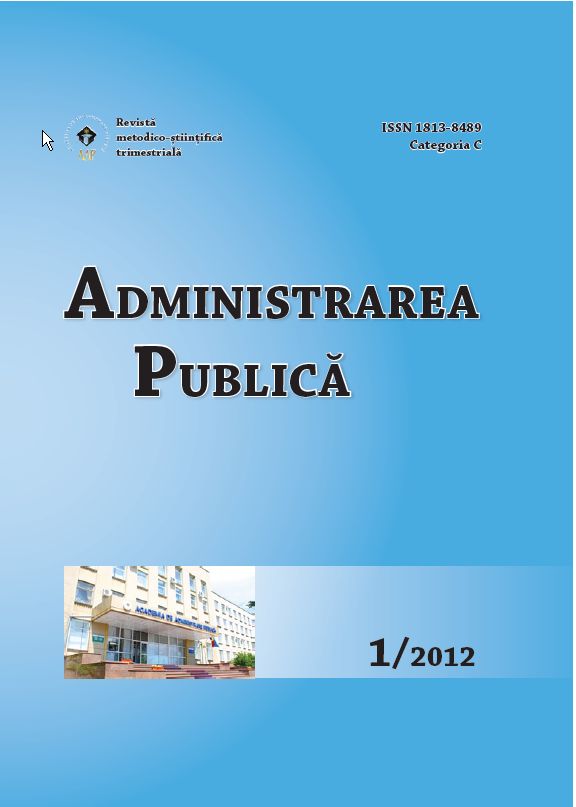 Revista „Administrarea Publică” - Nr. 1 (73), ianuarie - martie 2012