-
 O viziune interdisciplinară asupra proceselor culturale europene
 Culture is the one that renders “European bond and can preserve a sustainable unity in such a vast diversity”. In this context, the role that culture has in the spiritual development of each nation, and of the Moldovan citizens in particular, is obvious. Currently, the European Union is playing an increasing role in cultural policy and European cultural cooperation. The study European cultural processes: implications for Republic of Moldova, written by Stela SPÎNU, PhD, treats the common values of Europe and Europeans, the EU’s Culture programme, the new cultural policies of the Republic of Moldova and the bilateral and multilateral cultural cooperation.
-
 Caracteristica şi modul apariţiei litigiilor individuale de muncă
 Of labor disputes are conflicts between employee and employer that can be solved by direct negotiations between the parties or with the participation of trade unions for the establishment or modification of working conditions their applications, conclusion, amendment and implementation of a collective agreement, on the social and working conditions. The employment disputes means the differences of the subjects of law and the law enforcement work, as well as other laws on labor, collective bargaining and other agreements, and the establishment of new or change the existing terms of labor occupancy, which is not covered by labor law.
-
 Технологизация государственного управления в Украине в контексте социальных и политических технологий
 This article analyzes the main trends of using management technologies in the political sphere and in the activity of public authorities in Ukraine.
-
 Особенности адаптации заимствованных политических институтов на постсоветском пространстве
 In the article the role of political institutions that were imported in transitive political systems of post-Soviet space is analyzed. The modern approaches of analysis of institutional transformations in transitive societies are used. The author grounds the features of the social actors` adaptation process to the institutional forms that were imported.
-
 Unele aspecte practice privind organizarea şi funcţionarea autorităţilor publice locale în municipiul Chişinău
 Local government is the main element in solving local problems, playing a key role in the development of municipalities and providing necessary public services to their citizens. Chisinau administration requires special attention since it is the capital of Moldova.
-
 Детерминанты преступлений против нравственности в сфере культуры
 The article is devoted to the problem of definition of causes and conditions (determinants) of committing crimes against morality in cultural sphere. Have been identified main determinants of every crime of this type. On the basis of this research were allocated causes and conditions of crimes against morality in cultural sphere in the complex.
-
 Probleme actuale ale controlului de legalitate al actelor autorităţilor administraţiei publice locale
 Moldova’s strategic vector is joining the European Union. This membership requires that Moldova has achieved stability of institutions guaranteeing democracy, the rule of law, human rights. An important objective of achieving European integration is to ensure the legality in all fields of the state, including local government, which will increase the administrative capacity of municipalities and districts. If Moldova is failing to strengthen administrative capacity, this fact will present an obstacle to the process of European integration. In the present agrticle, the author examines some theoretical and practical aspect of the legality of the control of the acts of local public administration.
-
 Система власти в современных государствах: причины изменений конфигурации и условий функционирования
 The paper describes the evolution of the current system of power in modern states and identifies the factors affecting the changes in its configuration. In a democracy and globalization these factors are the social networks of trust, conceptual inequality and the existence of latent power structures that lead to the emergence of new institutions of power, but also significantly affect the nature of relationships within the current system of government, forcing it to evolve, creating comfort for the operation of each of the its constituent bodies of power.
-
 Noţiunea şi trăsăturile caracteristice ale conflictului colectiv de muncă prin prisma legislaţiei Republicii Moldova şi a legislaţiei române
 This paper is intended to clarify the criteria used to differentiate the individual from the collective nature of labour disputes in labour law, and to cast light on processes and powers assigned to the actors to seek a settlement. Also, the current research is aimed at conceptually approaching the juridical institution of collective labour disputes by means of national legislation and doctrinal opinions.
-
 Ceauşescu în faţa lui Brejnev: Basarabia, pământ românesc!
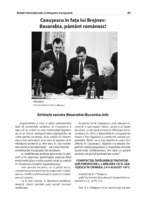
 În opinia lui N. Ceauşescu, este absolut incorectă şi sub aspect istoric, social şi al luptei de clasă, şi sub aspect marxist afirmaţia că includerea, în 1812, a Basarabiei în componenţa Rusiei a fost legitimă şi conformă voinţei popoarelor. Nimic nu a fost legitim în acest act, afirma N. Ceauşescu. Alipirea s-a produs împotriva voinţei poporului şi împotriva dorinţei Guvernului moldovenesc. Am dori ca autorii sovietici să spună lucrurilor pe nume.”
-
 Parteneriatul cu Alianţa Nord-Atlantică – mecanism de valorificare a opţiunii europene
 On the basis of the above we determined that the relations between the Republic of Moldova and NATO are marked essentially by two factors, the status of neutrality auto-proclaimed the presence of the Russian Federation, both having repercussions in relation to the problem of identifying viable solutions to the conflict in the eastern region. The Republic of Moldova can not ignore the partnership with such an important actor, NATO, even if it is not on the list of priorities of the Organization, the lack of evidence guest list at the Chicago Summit. Currently the Euro-Atlantic integration of the Republic of Moldova does not sit on the agenda, especially due to constitutional difficulties, geopolitical mentality and character, but the partnership with NATO remains a sustainable opportunity to capitalize, including the military dimension (modern armament National Army), political (providing support organizations to promote national interests) and non-military, joint projects (purchase of equipment and technology).
-
 Traditional and modern teaching/learning methods by using ICT instruments
 În scopul dinamizării procesului de instruire, al sporirii atractivităţii procesului didactic, a îmbunătăţirii condiţiilor de predare-învăţare a disciplinelor socioumane, este necesară şi benefică diversificarea metodelor şi tehnicilor didactice prin utilizarea instrumentelor TIC (a resurselor hardware şi software). Ajustând TIC la cerinţele procesului de predare-învăţare, remarcăm că studenţii/masteranzii devin mai receptivi la posibilităţile pe care acestea le oferă, învăţând să profite de larga gamă a informaţiilor, astfel fiind înlăturate impedimentele existente.
-
 Parteneriatul public-privat - o soluţie pe termen lung pentru atragerea investiţiilor private în infrastructura Republicii Moldova
 The public-private partnership represents a solution for attracting foreign investments from the private sector into the infrastructure of the country. A developed country has to have a modern and functional infrastructure and one of Moldova’s long term priorities is development of the infrastructure, which can be realized through the implementation of PPPs where the major part of the investment is coming from the private partner. Here we talk about the infrastructure of the roads, railroads, airports, as well as the sewerage and wastewater systems, the protection of the environmental-collection, waste acquisition and storage, social programs which include the renovation of schools, hospitals and residential centers. At the moment in Moldova the number of P.P.P. projects is not that big, 15 ongoing, 15 in the process of preparation for the selection of the private partner and 32 were suggested for initiation in 2011. A successful P.P.P. project depends on the political and economic conjuncture of the country, this is why it needsf the support from the public partner and the manifestation at the highest level by the private one. Moreover, the inefficiency of this kind of projects in Moldova is basically because of the lack of knowledge about the mechanism of public-private partnerships and the absence of the competitive factor which is mostly because of the lack of public partners finances. In Republic of Moldova we need to put in application the P.P.P. legislation and start implementing it at the highest level. We need more than 15 functional public-private partnership projects and a lot of trainings, support and will from the private partner, who has to import the European experience in this domain.
-
 Teorii privind echilibrul şi dezechilibrele economice
 This article emphasizes the essence of different theories on economic equilibrium and imbalances; the types of equilibrium; the factors influencing the state of equilibrium and the state of imbalance; the consequences of unimportant disturbances on the economic life.
-
 Servitutea internaţională
 The fact that many theorists now operate with the term of servitude for the qualification of certainfacts, the events on the international arena requires the avoidance of the arbitrary use of this term, which until the last century was seen as a pure concept of Private Law. The main goal of this article is to elucidate the legal content of this institution of law, and to achieve a systemic approach, especially to detect the correlation between the following terms: servitude, state territory, state sovereignty and territorial sovereignty. Also, we aim to provide answers to the following points: automatic transmission of aservitude from one state to another; types of international servitude, expectations of the institution of international servitude on the contemporary stage.
-
 Ultimele tendinţe de supraveghere bancară la nivelul Uniunii Europene ca urmare a crizei economico- financiare: impact asupra Rusiei şi Moldovei
 In this scientific article, we are trying to conduct a research into the problem of the established Banking Supervision system within the European Union. A special interest is paid on Jacques de Larosiere’s Report – “The High-level group of financial supervision in the EU” published in February 2009. As it is clear understandable, the report lays out a framework to take the EU forward towards: a) a new regulatory agenda (to reduce risk and improve risk management; to improve systemic shock absorbers); b) stronger coordinated supervision (macro-prudential and micro-prudential with much stronger coordinated supervision for all financial actors of the EU); c) effective crisis management procedures – to build confidence among supervisors. To some extent, the authors will argue that the banking reform led to a new Directive 2010/78/ EU of the European Parliament and of the Council amending some EU directives in respect of the powers of the European Supervisory Authority (European Banking Authority), the European Supervisory Authority (European Insurance and Occupational Pensions Authority) and the European Supervisory Authority (European Securities and Markets Authority). The study is finalizing with the analysis of Russia’s recent decision to transfer the attributions of its Security and Markets Authority to the Central Bank of Russia. Finally, we propose to the Parliament of the Republic of Moldova to amend our legislation and to create only one Supervision Entity under the National Bank of Moldova, which will supervise the banking and the financial sectors.
-
 Consideraţii generale privind cetăţenia română
 Citizenship are interested not only Constituţional right but equally and internaţional law (in părţicular public and private), family law, a determination by the excellent interdisciplinary. The Constituţion and the laws grants citizens all rights (including the political ones), while persons who do not have this quality, giving them not only a part of these rights.
-
 Cu privire la obiectivele regionalizării în Uniunea Europeană
 La reforme administrative teritoriale deroule les dernieres annees par laquelle on a passe des raioane aux judeţe et de nouveau aux raioane constutue une preuve du vaite que ce probleme n’ est pas simple et quil necessite un traitement par le prisme des standard européens. L’orientation de la politique nationale vers l’intégration dans l’Union Européenne imose la conformité aux standards européens d’organsation administrative du territoire. Ces standards réclament la reconnaissance du principe de l’autonomie locale au niveau local et régional. Il faut mentionner qu en ce qui concerne l’aspect régional celui-ci implique l’organisation des régions capables de se gérer elles-mêmes, sans définir leur dimension territoriale.
-
 Elementele structurale ale procesului decizional: reflecţii analitice
 One of the most common activities of human beings is that of decision-making. Every person is constantly deciding on a wide variety of different subjects. We all know, from our particular experience, that there are good and bad decisions, so a natural question arises. Are there any rules or procedures for decision-making which “guarantee” that the final result is a “good” decision? So, further in this article, we are going to describe and analyze, those structural elements, which are important for a making-decision process, such as decision to be rational. Decider, the problem situation, the decisional objects, the multitude of decisional alternatives, decisional criterions, the consequences for each alternative, and de making choice are the structural elements which each decision-making process should encounter for its rationality.
-
 Unele aspecte ale controlului parlamentar asupra administraţiei publice. II. Guvernul Republicii Moldova
 The control’s institution has a key in the functioning of social sistems. For government the control to chek opportunity and correct functioning of public autorities in terms of their effectivenes. A special role in execising the control over function of public administration lies with Parlament. In this article it is addres some aspects of parlamentary control exerscise over the Govern. The Government is executive power in a state, and realizes its activity Program based on vote of confidence by the Parliament. Supervision by legislature, through forms and legal means, to compliance by Government of constitutional regulations guarantees functioning of law state.
