-
 Unele aspecte ale politicii externe a Republicii Moldova în contextul evoluţiei situaţiei geopolitice din regiune
 This article reflects the regional geopolitical situation in the light of some aspects of foreign policy of the Republic of Moldova. The article highlights the extent to which developments in the region may have an impact on Moldova. Thus the article deals with economic and social issues of national security, the topic that relates to the Transnistrian settlement in the context of new realities.
-
 Subsistemele regionale din Orientul Mijlociu în abordările teoretico-metodologice din Federaţia Rusă
 The paper focuses on the historiographical analysis of the topics defining researches, elaborated by scientists from Russia, defining the conceptual-theoretical landmarks of the research concerning the regional subsystems and centers of power in the Middle East, helping to substantiate the researches on Regional Studies. The authors elucidate the arrangements that are ongoing in the Muslim area appeared after the Cold war, determining the character and peculiarities of the international geopolitical conjuncture, regional and subregional factors, which impact on the formation or reconfiguration of the certain subsystems and centers of power, identifying the affinities, interests and their vulnerabilities on the light of the Russian experts’ researches. The paper presents a wide-ranging study that elucidated the dynamics of the subsystem reconfigurations of the Middle East: it is elucidated the resizing of the place and role of the countries from the mentioned area as a result of the transformation of the post-Cold war, identifying the determinant factors and their impact. It was elaborated, on horizontal plan, the segmentation of Muslim geopolitical space in the sub-regional systems and sub-regional centers of power as parts of a homogeneous unit, based on affiliation to religion and Islamic civilization.
-
 „În centrul politicii externe se află protejarea şi promovarea intereselor ţării şi ale cetăţenilor noştri”
 Interviu cu dna Natalia GHERMAN, viceprim-ministru, ministru al afacerilor externe şi integrării europene al Republicii Moldova
-
 Platforma tehnologică guvernamentală comună (MCloud) – o nouă etapă în reforma administraţiei publice
 The Government of Moldova has successfully completed the piloting use of Cloud Computing by ministries and government agencies. Launched on February 2013 with the World Bank support, the private government cloud (MCloud) is now used by 19 government ministries and agencies to deliver eGovernment services to the public. The major MCloud products - IaaS, MPass (government authentication and access control service), MSign (government digital signature service), and MPay (government electronic payment gateway) – are all experiencing rapid take-up, both by the government clients and citizens. Electronic services hosted on the MCloud Platform are highly demanded and adopted by the public. The e-Government Center/Government CIO in partnerships with sectorial ministries are piloting new services for content management, document management and data exchange, to support governance digital transformation and modernization and improved public service-delivery. Because of its popularity, MCloud Phase I has reached the limits of its capacity in a year from the launching. Also, in order to improve its resilience and security, the second remote data center is required.
-
 Recomandări metodice pentru candidaţii la studii prin doctorat privind elaborarea referatului ştiinţific
 TA form of training highly qualified scientists is the doctoral studies Admission to doctoral studies is realized through a selection among candidates, who have demonstrated deep theoretical knowledge and got the necessary skills for achieving PhD program.
-
 Gândirea japoneză Kaizen – cheie privind succesul dezvoltării organizaţionale
 Kaizen means improvement, continuous improvement involving everyone in the organization - from top management to managers, then to supervisors and to workers. In Japan, the concept of Kaizen is so deeply ingrained in the minds of both managers and workers that they often do not even realize they are thinking Kaizen as a customer- driven strategy for improvement. According to Imai, this philosophy assumes that „our way of life – be it our working life, our social life or our home life – deserves to be constantly improved’’. The Kaizen Institute defines Kaizen as the Japanese term for continuous improvement. It is using common sense and is both a rigorous, scientific method using statistical quality control and an adaptive framework of organizational values and beliefs that keeps workers and management focused on zero defects. It is a philosophy of never being satisfied with what was accomplished last week or last year.
-
 Платежный баланс страны как объект государственного регулирования экономической деятельности
 The research is devoted to the study of state balance of payments - a set of active economic, financial and monetary measures to form its main articles. Weak current spontaneous alignment balance mechanism through automatic price adjustment policy is opposed by active equalization deficit deflationary contraction in aggregate demand, and the application of special measures direct state regulation of foreign accounts.
-
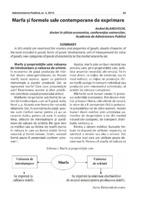 Marfa şi formele sale contemporane de exprimare
 In this article are examined the essence and properties of goods; double character of the work included in goods; forms of goods’ development; unit of measurement for value of goods; new categories of goods characteristic to the market economy etc.
-
 Evoluţia în timp şi dezvoltarea conceptului de dezvoltare durabilă
 The sustainable development involves caring of human society to the current situation and forthcoming its natural resources, the energy, materials and the informational. The sustainable regional development represents the process of exploiting the economic potential, natural and human resources, ensuring balance between the socioeconomic and the natural potential of and for the next generation by diversifying, developing and streamlining the sectors of the economy to improve the people quality of life, to increase the citizen involvement in identification of the clear and developing directions that they can achieve.
-
 Aspecte generale privind Curtea Constituţională a României
 Total independence of the Constitutional Court in the state and the powers to declare unconstitutional a law voted by the parliamentary majority or an ordinance of the Government, which leans on a parliamentary majority makes prevail the Constitutional Court opinion and has a particularly important place in activity of the state’s three powers: legislative, executive and judicial.
-
 Rolul Băncii Centrale Europene în domeniul supravegherii bancare
 The authors are conducting a research into the problem of the European Central Bank (ECB) in the light of its functions with a special attention paid to the task of supervising the banks of the European Union. As it is known, the ECB is the central bank for the euro and administers the monetary policy of the Eurozone. It is one of the world’s most important central banks and is one of the seven institutions of the European Union listed in the Treaty of European Union. The capital stock of the bank is owned by the central banks of all 28 EU member states.
-
 Consideraţiuni generale cu privire la evoluţia instituţiei şefului de stat
 Regardless of the level of community’s evolution, from less to more organized, this had an acknowledged leader, chosen or imposed, depending on the historical circumstances. The institution of head of the state, from an organizational point of view, has known either personal or collective forms of organization. In our country, the evolution of this institution is not radically different from the evolution of this institution in other countries, the differences and particularities are dictated by the historical and political conditions in which our state has been evolving. In this article we will analyze the general aspects of the evolution of the political institution of the head of the state.
-
 Reforma administraţiei publice în Republica Moldova din perspectiva Acordului de Asociere cu Uniunea Europeană
 Within this study are examined the retrospectives of Moldova-EU relations in public administration, are exposed some reflections on the provisions of the Association Agreement between Republic of Moldova and European Union (signed on June 27, 2014) with reference to public administration, are identified the degree of convergence between the Moldovan administrative system and European Administrative Space.
-
 Premisele culturii profesionale a funcţionarului public
 This article treats the professional culture of the civil servant. The author attempts to identify the social premises, individual and corporate culture that determines the content and professional development. The author offers functional-axiological approach to professional culture, promoting the idea of forming complexes technological skills of civil servants and complete this with communicative skills-based literacy.
-
 Perspective ale securităţii naţionale la limita bazinului Mării Negre în contextul geopolitic şi geostrategic al securităţii globale
 The Black Sea has, for centuries, presented each coastal state with a security perspective carrying different particularities. This sea, located between the Balkan, Crimean and Anatolian peninsulas and the Caucasus, forms the maritime heartland of Eurasia. The transport system of the Danube River, stretching between the Turkish Straits and Germany, and the internal regional waterways of Russia and the Ukraine carry separate strategic significance to the Black Sea.
-
 Carenţe privind determinarea conţinutului dreptului fundamental al omului la un mediu înconjurător sănătos
 Fundamental right to a healthy environment is the natural right of human beings to live in a favorable natural environment conducive to his physical and mental development, of ecologically harmless to life and health, while also being designed as a safeguard rights to life and health, because none of these rights is not conceivable without a healthy environment, balanced and prosperous, which places then as a constitutional right with a multifunctional containing.
-
 Răspunderea juridică a salariatului în cazul neexecutării sau executării necorespunzătoare a obligaţiilor de organizare a securităţii muncii
 Legal liability embodied in its specific type, is an institution of law, soit is a set of legal rules governing legal relations sanctioning the person who violated the law or ordering it to material damage, moral damage caused, to restore the previous situation of legal norms and subjective rights protected by these rules. Since the conclusion of the individual labor contract, employer must create all the conditions in order to assign all the duties by the employee, and the employee, in turn, must respect work discipline strictly. Given aspect of the conduct of labor relations is one of particular importance, dictated, in particular, that can touch the supreme values of society - life and health. Legal liability of the employee is properly regulated (corresponding adjective implies the possibility of application to the offender a sanction and to impose the damages, after completing a legal and equitable investigation procedure) at all levels of manifestation of coercion: criminal, administrative, material, civil, disciplinary.
-
 Autonomia locală – principiu de organizare şi funcţionare a administraţiei publice locale în Republica Moldova
 Local autonomy is the fundamental principle which underpins the development of local public administration. It is an element of „democratic principles common to all Member States of the Council of Europe” by regulating its legal and practical application makes it possible to decentralize power. Local autonomy makes possible to establish a distinct status of local and their governing bodies in relation to central government.
-
 Основные этапы и направления исследований политической идентичности
 The paper investigates the actual question of political theory and practice - the process of forming a political identity. Political identity is treated as an object of interdisciplinary research, marked its components such as the historical, religious, linguistic and socio-cultural.
-
 Eficientizarea managementului serviciilor publice desconcentrate în Republica Moldova
 Local public services can be classified as decentralized, deconcentrated and delegated. Deconcentrated public services are organizational units of central public authorities within the territories of the country. In the Republic of Moldova, these services are subordinated to the Government, while the State Chancellery is responsible for their coordination. Since 2003, there is a negative trend in the number of deconcentrated public services, territorial units and staff in Moldova. Also, their quality and accessibility for citizens is not high. Moreover, there is no clear distinction between different categories of local public services in the national administrative legislation and practice. The National Decentralization Strategy for 2012–2015 is expected to resolve these problems.
-
 Schimbarea de paradigmă teoretică a extinderii Uniunii Europene
 There exist varying goals and different emphases throughout the EU enlargement process. Enlargement has been seen as a positive political obligation, not only for the EU but also for candidate countries, which assume that EU membership will bring more prosperity. However, such a statement may not be as valid for some states as it seemed only a few years ago. The article is looking answer to a question whether all the canons and requirements for the candidate states can be the same as they were before the Lisbon Treaty. The balance in competences between member states and the EU is changing. The European crisis and the formation of a ‘new Europe’ that may be more fragmented on the basis of belonging to the euro zone, Schengen area and other regional arrangements and finally the changes in global political agendas are influencing the enlargement processes. Article elaborates on the different problems the states like Bulgaria, Rumania or Balkans had in their accession process expected by different stakeholders.
-
 Aspecte ale securităţii datelor în spaţiul virtual
 This article addresses the subject of the extent of the dangers of the virtual environment and ways to prevent them in the EU Council through the EU Cyber Security Sttrategy. Various methods of secure data management and user accountsare proposed, and formulated requirements for creating secure passwords; introduction to the notion of password generating programs and passwords to access accounts, which can solve problems of data security in cyberspace.
-
 Există sau nu deosebire între conceptele „muncă” şi „forţă de muncă,” „piaţa muncii” şi „piaţa forţei de muncă”?
 The purpose of this article is the highlighting of the difference between the economic categories „work” and „workforce;” „wares” and wares-workforce.” Here are examined the unity and distinction of this categories and „exchange value” of the wares-workforce; „needed work” and „extrawork”; content and peculiarities of labor market.
-
 Реклама: сущность и особенности в Республике Молдова
 Based on the previous experience of the publicity in the small business activity studied in Republic of Moldova. This article proposes some directions of improvement this process in our country.
-
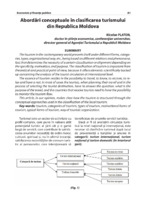 Abordări conceptuale în clasificarea turismului din Republica Moldova
 The tourism in the contemporary world presents itself under different forms, categories, types, organizational way, etc., being based on different relations and phenomena, fact that determines the necessity of a certain classification or alignment depending on the specificity, motivation, and purpose. The classification of tourism is important from theoretical and practical point of view, because it offers elements scientifically backed up concerning the analysis of the tourist circulation at international level. The essence of tourism resides in the possibility to travel, to know, to recover, to relax and have a rest. In most of cases the tourists, when planning their travel and in the process of selecting the tourist destination, have to answer the question: what is the purpose of the travel, and the countries that receive tourists need to have the possibility to monitor the tourism flow. This article, in our opinion, makes clear how the tourism is structured through the conceptual approaches used in the classification of the local tourism.

 Revista „Administrarea Publică” - Nr. 1 (81), ianuarie - martie 2014