-
 Eficienţa politicii manageriale în modernizarea activităţii profesionale a funcţionarilor publici
 The topic discussed in the present article is given because now increase the share of those who will work in research, but the modalities of direct involvement in the final result will be very different. The fastest growth rates of labor supply is recorded in the application areas of nanotechnology, information technology, biotechnology. In general there is a tendency to shift the weight of skills, from sensory and intellectual skills for driving. To strengthen the administrative capacity of the PA is required to take into account new trends in human resources, the major changes that have taken place in all areas of social life and the evolution of motivation methods used to increase the efficiency of their work.
-
 Interdependenţa dintre eguvernarea Republicii Moldova şi retehnologizarea tehnologiilor informaţionale şi comunicaţionale
 This scientific article exploits a major theme of eguvernamentale directives to 2020 relating to upgrading all areas of national activity which may include the development ICTs worldwide. Upgrading ICT planning ICTs is the advanced study what interested actual the world of science to facilitate human life, to ensure the process of integrity eGovernment and more than to make a redistribution of population welfare by using ICT potential according to international standards etc.
-
 Unele aspecte privind rolul autorităţilor publice centrale în asigurarea transparenţei decizionale
 After analyzing existing legal framework and central public administration’s activities, it must be noted that in the Republic of Moldova there is an adequate legal framework consisting of rules and regulations which observance ensures the principle of transparency. Communication of public central administration with the citizen is twodirectional and mostly occurs through new informational technologies. However, there are still some deficiencies in this communication, mostly due to the citizens’ lack of activism. For this purpose, we believe it is imperative for the representatives of the civil society, of academia, and of expert groups to be more active and involved, to analyze existing draft bills, to participate in public consultations, to analyze thoroughly existing initiatives and to express their opinion on those. On the other hand, civil servants and public officials must be also more open to cooperation, and must take the opinion of the civil society into account. Thus, if public administration has committed to act in the spirit of the transparency principle, then this transparency must be a real and participatory one, given only a bilateral cooperation is a precondition of public support.
-
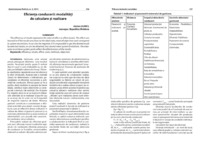 Eficiența conducerii: modalități de calculare şi realizare
 The efficiency of results represents the ratio of effect to effort (costs). The effect can be positive if the results are closer to the ideal state, meet all objectives and correspond to system restrictions. It can also be negative, if it’s impossible to get the desired result by selected means; or can be obtained, but cannot meet system limitations. The measures to achieve system goals reflect the effectiveness of the results.
-
 Evoluţia poziţionării Republicii Moldova în diverse clasamente internaţionale
 The countries can be compared by different criteria and indicators. We can distinguish at least 3 types of international ratings: analytical, Millennium Development Goals and synthetic. The global position of the Republic of Moldova in most international ratings improved in recent years, but we are frequently in the second half of the list and we have more weaknesses than strengths. The latter may be strategically vulnerable and need more attention of the competent public authorities.
-
 Asigurarea egalităţii de gen în contextul prevederilor Acordului de Asociere Republica Moldova – Uniunea Europeană
 The 27th of June 2014 Republic of Moldova starts a new page in its history, Republic of Moldova and European Union has signed the Association Agreement. This Agreement shows the Moldova’s aspirations to the European future and returning to the European Family. The Association Agreement targets important areas such as economic sector, public administration, social policy, consumer protection, public finance, fiscal policy etc. There are some important objectives for the gender politics which provide gender equality in politic, social and economic life. These objectives should be implemented by reforms and political dialogue at all the levels. There is a need not only in political will, but in cooperation between Moldova’s executive and legislative organs and the massive implication of civil society. The first step is the establishment of rates of the women participation in politics and their representation on the electoral lists. The legal framework should provide all the mechanisms of women’s participation in decision-making process. The Association Agreement represents the way to the implementation of the necessary reforms and modernization of the Republic of Moldova.
-
 Rolul relaţiilor politice şi administrative în procesul de implementare a Strategiei naţionale de descentralizare
 The adoption by the Parliament of the Republic of Moldova in April 2012 of the National Strategy on Decentralization was an important step for reforming public administration system and ensuring real autonomy of local powers. It comprises also a lot of recommendations that have to be implemented in order to create a stable and efficient framework for developing the public administration system, as well as the political one. In this context, the paper will emphasize the role of political and administrative relations in the implementation process of National Strategy on Decentralization`s action plan, as well as problems that occurred in the process between politicians and civil servants, passing through the transition period.
-
 Intercultural communication in a globalized world: realities and perspectives
 I would like to begin this lecture with Eugen Ionescu’s statement „There are many things that separate us in the world, but there is also one that brings us closer: culture”. Culture sums up all the values, norms, meanings, intentional actions and behavioral attitudes, as well as material supports, which ensures their dissemination and dynamism.
-
 Gândirea diplomatică în Orientul Antic
 The most important knowledge about early diplomacy are coming from the Middle East, the Mediterranean, China and India. During this time the diplomacy had an itinerant character. The ambassadors, diplomats, were sent to declare war, to conclude peace treaties, alliances or trade agreements. During this period there were diplomatic documents, transactions and diplomatic actions. But there were no notion of ambassador or resident diplomat, very precise rules. The diplomatic activity had an adhoc character and was not ci sufficiently well organized.
-
 Perspectivele implementării ecotehnologiilor informaționale în infrastructura inovațională a Republicii Moldova
 The technologies advance in an accelerated rhythm and are applied at all the organizational levels of the social and economic life. The adaptation to the imposed rhythm of changes of the new technologies presupposes a good international cooperation in the transfer and implementation of them in the production process. The technological progress has affected, as well, the information systems both of the public organisations and of the private ones, imposing new forms of public partnership in an era which can be called eco-TIC, which reveals the IT impact on the requirements of the durable development.
-
 Provocările dezvoltării regionale în secolul al XXI-lea
 Regional development is about the geography of welfare and its evolution. To see changing regional welfare positions we often use gross domestic product (GDP) per capita as a statistical approximation. Complementary measures are also used, such as per capita consumption, poverty rates, unemployment rates, labor force participation rates or access to public services. These indicators are more social in nature and are often used in United Nations welfare comparisons.
-
 Asigurarea calitativă a sistemului de securitate a informaţiilor din Republica Moldova în perioada de criză economică
 The article describes the basic concepts of information security of the country, the principles of information security system. It has been proposed and explained the main directions for managing information security of the country.
-
 Estimarea securităţii economice şi diminuarea riscurilor
 Economic security is mesasured as a combination of the normalized values of the seven socio-economic security indexes to yield a composite measure designated the Economic Security Index (ESI). The ESI is defined as a weighted average of the scores of the seven forms of security, in which double weight is given to income security and to representation security, for reasons that basic income security is essential for real freedom to make choices and that representation security is essential to enable the vulnerable to retain income security. Understanding the complex systems nature of national security and why the economy is a part of the equation is crucial. The world is a very small place, and world peace may depend upon our ability to understand and articulate these issues—and in particular to recognize the importance of the economic element of national power. Each country is uniquely endowed with their own level of economic development, a capacity for risk management, a national culture and its position in the international environment, each will invariably perceive economic security differently. For developing countries, such as China, economic security is best defined as the ability to provide a steady increase in the standard of living for the whole population through national economic development while maintaining economic independence. In other words, there are two sides to the economic security ‘coin’: competitiveness and independent economic sovereignty. Competition generates healthy development while a degree of autonomy guards against undue external influence on the economy. Economic competitiveness is vital not only to stimulate national economic growth, but also to penetrate the international market. In an era of globalization, the two are inextricably linked as no country can close itself off to challenges from the outside.
-
 Teorii şi politici de comerţ exterior
 Comerţul exterior reprezintă cea mai veche formă de legături economice realizate între ţări. La început, obiectul principal al tranzacţiilor comerciale l-a constituit schimbul de mărfuri cu grade diferite de prelucrare (începând cu cele primare agricole, de extracţie şi continuând cu cele manufacturate).
-
 Importanţa Parlamentului ca instituţie de stat
 Definit ca „organ de stat colectiv, compus, în general, dintr-un număr important de membri aleşi şi care reprezintă interesele unei întregi populaţii, legiferează şi controlează executivul”,2 Parlamentul României, singurul detonator al puterii de a reglementa prin lege relaţiile sociale, emite legi constituţionale, legi organice şi legi
ordinare (art. 72 din Constituţie). Iniţiativa legislativă aparţine guvernului, deputaţilor, senatorilor, precum şi unui număr de, cel puţin, 250.000 de cetăţeni cu drept de vot. Nu pot face obiectul iniţiativei legislative a cetăţenilor problemele fiscale, cele cu caracter internaţional, amnistia şi graţierea (art. 73, alin.1 din Constituţia României).
-
 Probleme teoretice și practice ale interpretării normelor juridice
 Interpretarea constituie o operaţie logico-raţională care, lămurind înţelesul exact şi complet al dispoziţiilor normative, oferă soluţiile juridice adecvate pentru diferitele
situaţii cu care ne confruntăm. Aşadar, interpretarea este „operaţiunea prin care se stabileşte o legătură logică între dreptul astfel conceput şi execuţia lui, încercându-se să se deducă aceasta din urmă din cel dintâi”.
-
 Principiul subsidiarităţii: definiţie, evoluţie şi tendinţe
 Evenimentele din ultimii ani au subliniat faptul că statele lumii nu mai pot supravieţui în mod izolat, că valorile intuite de antici în ceea ce priveşte existenţa statului pot fi promovate doar în acest nou context european şi mondial. Statul modern nu mai poate vorbi de centralizare absolută, colectivităţile locale sunt puse în lumină din ce în ce mai mult, iar cetăţeanul ocupă un rol primordial în evoluţia statului modern. Autonomia locală este un principiu fundamental de funcţionare a colectivităţilor locale şi are în vedere rezolvarea intereselor locale de către autorităţile reprezentative din unităţile administrativ-teritoriale.
-
 Administrația publică postmodernistă și Noul serviciu public
 La începutul anilor `70 ai secolului al XX-lea, mai mulți teoreticieni ai administrației publice au urmat colegii lor din alte domenii (variind de la artă și arhitectură până la sociologie și filozofie) în a aborda ideea de postmodernism. Astfel, au început să exploreze mai critic abordările teoretice care stau la baza modelului rațional de administrare. Elementul fundamental al acestei explorări a fost ideea că administrația publică, asemenea altor științe sociale, a devenit dependentă de abordarea particulară a teoriei pozitivismului și că această abordare limitează subtil, dar dramatic intervalul de gândire posibil în domeniu.
-
 Interconexiuni teoretico-metodologice şi aplicative în evoluţia reformei administrației publice din Republica Moldova
 Administraţia publică din Republica Moldova evoluează odată cu schimbările de ordin politic, economic, social, implementând noi principii de administrare, tehnologii manageriale performante, asigurând prin aceasta ireversibilitatea proceselor democratice din societate.
